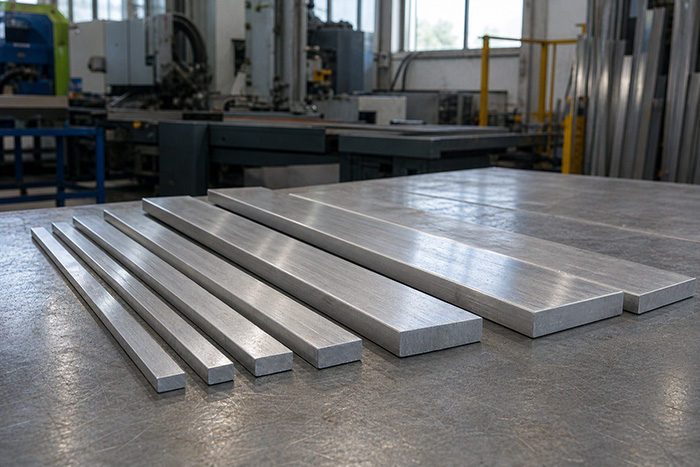
Aluminium flat bar is specified by width × thickness × length. Common metric stock dimensions include widths from 10 to 200 mm, thicknesses from 3 to 25 mm, and lengths from 1,000 to 6,000 mm, although larger sections and cut-to-length products are available from specialist manufacturers. The right size depends on more than physical fit: alloy, temper, tolerance, surface condition, load and—when the bar carries current—electrical performance all matter.
This aluminium flat bar sizes and specifications guide is for electrical engineers, fabricators, OEM buyers and procurement teams. It explains how to read dimensions, estimate weight, compare alloys and prepare an accurate request for quotation (RFQ).
Quick Answers
What are the most common aluminium flat bar sizes?
Common aluminium flat bar sizes start near 10 × 3 mm and extend through sections such as 50 × 10 mm, 100 × 10 mm and 200 × 10 mm. Stock lengths are often 3–6 m, but no single size list applies to every alloy, temper, process or supplier.
What information defines an aluminium flat bar specification?
A complete aluminium flat bar specification states width, thickness, length, alloy, temper, dimensional standard, tolerances, edge condition, surface finish, fabrication, inspection documents and quantity. Electrical busbar orders should also state conductivity or resistivity requirements and the applicable test method.
Is aluminium flat bar the same as aluminium busbar?
Aluminium busbar is a current-carrying application of aluminium flat bar, not a synonym for every rectangular aluminium bar. Busbar selection adds electrical conductivity, temperature rise, joint resistance, insulation, clearance and short-circuit withstand to the dimensional and mechanical requirements.
What Is Aluminium Flat Bar?
Aluminium flat bar is a solid, straight aluminium product with a constant rectangular cross-section, specified by width, thickness and length. Also called aluminium rectangular bar or flat stock, it is commonly extruded, although rolled and cold-finished products are also available. The manufacturing route affects the applicable specification, achievable tolerances and surface condition.
Flat bar is used for brackets, frames, supports, machine components and architectural details. High-conductivity grades are also manufactured as aluminium busbar for switchgear, power distribution, energy storage, electric vehicles and other AC or DC systems.
That distinction is important. A structural flat bar is selected mainly for strength, corrosion resistance, machinability and finish. An electrical busbar must also meet conductivity, resistance, temperature-rise, joint and short-circuit requirements. A bar that physically fits a cabinet is not automatically suitable for its current duty.
How Are Aluminium Flat Bar Sizes Stated?
The usual dimensional order is:
Width (W) × thickness (T) × length (L)
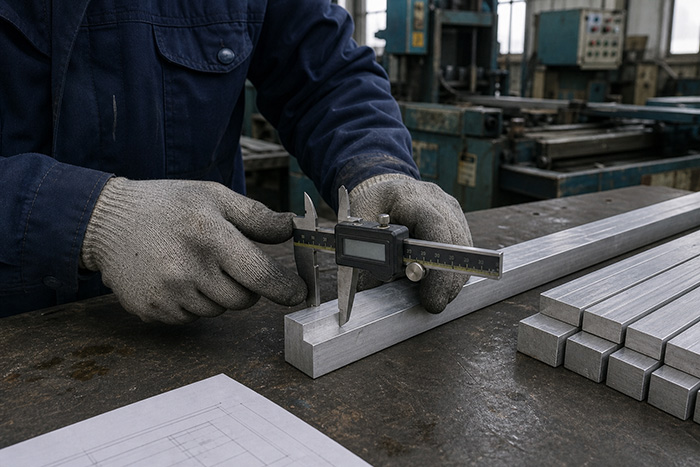
For example, 50 × 6 × 3,000 mm describes a bar that is 50 mm wide, 6 mm thick and 3,000 mm long. Its nominal cross-sectional area is 300 mm².
Always include units on drawings, purchase orders and RFQs. Imperial dimensions should be identified explicitly—for example, 2 in × 1/4 in × 12 ft—rather than mixed with metric values. Also state whether the dimensions are nominal or finished dimensions after machining, plating or other processing.
Standard length versus cut-to-size
Stock lengths often fall between 3 m and 6 m, while specialist suppliers may offer material from approximately 1 m to 6 m or produce project-specific lengths. Cut-to-size supply can reduce scrap and workshop time, but the buyer should specify length tolerance, squareness, burr limits and protective packaging.
Square corners versus rounded edges
Extruded flat bars can have slightly radiused corners. Busbars may also be ordered with rounded edges to improve handling, coating coverage and electric-field distribution in certain high-voltage applications. If edge geometry affects clearance, insulation or mating parts, add the required corner radius or edge condition to the drawing.
Common Aluminium Flat Bar Size Chart
The table below lists frequently encountered metric combinations and their approximate mass. It is a planning reference, not a universal stock list. Availability depends on alloy, temper, manufacturing route and supplier tooling.
| Width × thickness (mm) | Area (mm²) | Approx. mass (kg/m) | Typical uses |
|---|---|---|---|
| 10 × 3 | 30 | 0.081 | Trim, light brackets |
| 20 × 3 | 60 | 0.162 | Light fabrication |
| 25 × 3 | 75 | 0.203 | Frames, supports |
| 25 × 6 | 150 | 0.405 | Brackets, light conductors |
| 30 × 5 | 150 | 0.405 | General fabrication |
| 40 × 5 | 200 | 0.540 | Frames, supports, conductors |
| 40 × 10 | 400 | 1.080 | Machine parts, busbar |
| 50 × 5 | 250 | 0.675 | Fabrication, electrical work |
| 50 × 6 | 300 | 0.810 | Panels, busbar systems |
| 50 × 10 | 500 | 1.350 | Structural parts, busbar |
| 60 × 6 | 360 | 0.972 | Power distribution components |
| 60 × 10 | 600 | 1.620 | Busbar and heavy fabrication |
| 80 × 6 | 480 | 1.296 | Distribution equipment |
| 80 × 10 | 800 | 2.160 | High-current assemblies |
| 100 × 6 | 600 | 1.620 | Wide busbar, support plates |
| 100 × 10 | 1,000 | 2.700 | High-current busbar |
| 100 × 20 | 2,000 | 5.400 | Heavy-duty components |
| 120 × 10 | 1,200 | 3.240 | Power and industrial systems |
| 150 × 10 | 1,500 | 4.050 | Large distribution assemblies |
| 200 × 10 | 2,000 | 5.400 | Wide conductors, heavy fabrication |
Commercial ranges can extend well beyond these examples. One published international supplier range lists widths of 10–600 mm, thicknesses of 3–120 mm and lengths of 1,000–6,000 mm (Yieh Corp., accessed August 1, 2026). These figures document that supplier’s stated capability; they are not a globally standardised catalogue or a confirmed capability of Henan Meisitu. Confirm the exact section before completing the design.
How to Calculate Aluminium Flat Bar Weight
For a solid rectangular bar, estimated mass per metre is:
Mass (kg/m) = width (mm) × thickness (mm) × density (g/cm³) ÷ 1,000
Using a nominal aluminium density of 2.70 g/cm³, consistent with the density basis used in published aluminium section-weight references from The Aluminum Association, the shortcut becomes:
Mass (kg/m) = width (mm) × thickness (mm) × 0.00270
For a 50 × 10 mm bar:
50 × 10 × 0.00270 = 1.35 kg/m
A 6 m length therefore weighs approximately:
1.35 × 6 = 8.10 kg
Actual mass can vary slightly with alloy density, extrusion tolerance, corner radii and machining. Use the supplier’s certified section mass for freight planning or contracts based on delivered weight.
Aluminium Flat Bar Alloys and Tempers
Size alone does not define performance. The alloy controls conductivity, strength, corrosion resistance, machinability and weldability; the temper describes the material condition created by thermal or mechanical treatment.
| Alloy | Main selection advantage | Common applications |
|---|---|---|
| 1060 / 1070 | High aluminium content and good conductivity | Electrical conductors and busbars |
| 1100 | Good formability, conductivity and corrosion resistance | Electrical work and general fabrication |
| 1350 | Electrical-conductor alloy | Power busbars and conductor components |
| 5052 | Good corrosion resistance and formability | Marine and formed components |
| 5083 | Strong corrosion resistance in demanding environments | Marine and heavy-duty fabrication |
| 6061 | Balanced strength, machinability and corrosion resistance | Structural parts and rigid busbar assemblies |
| 6063 | Good extrudability and surface finish | Architectural profiles and lighter-duty sections |
| 6101 | Conductivity-strength balance for electrical use | Busbars and power distribution equipment |
| 7075 | High strength, lower emphasis on conductivity | Highly loaded mechanical parts |
For electrical projects, 6101 aluminium flat bus bar is often considered when both conductivity and mechanical strength matter. 6061-T6 aluminium flat bar busbar is useful where rigidity, machinability and structural performance have greater weight in the design decision.
Common temper designations include:
- O: annealed for maximum softness and formability;
- H112: slightly strain-hardened through the manufacturing process;
- T5: cooled from an elevated-temperature shaping process and artificially aged;
- T6: solution heat-treated and artificially aged;
- T651/T6511: solution heat-treated, stress-relieved by stretching and artificially aged, with T6511 allowing minor straightening.
The same alloy can behave very differently in different tempers. Never approve a substitution based on alloy number alone.
Standards, Tolerances and Surface Requirements
The standard named on the order should match the manufacturing route and end use. ASTM International’s ASTM B221/B221M covers extruded aluminium and aluminium-alloy bars, rods, wire, profiles and tubes. ASTM International directs rolled or cold-finished bar, rod and wire to ASTM B211/B211M. European procurement commonly references EN 755 for extruded rod/bar, tube and profiles or EN 754 for cold-drawn products; purchasers should verify the required part and current edition with their project specification or standards provider.
Electrical-purpose material needs additional attention. ASTM B236/B236M covers Aluminum 1350 bar for electrical conductors in specified tempers. International Electrotechnical Commission (IEC) 60105 addresses the electrical properties of commercial-purity aluminium busbar material regardless of cross-sectional shape.
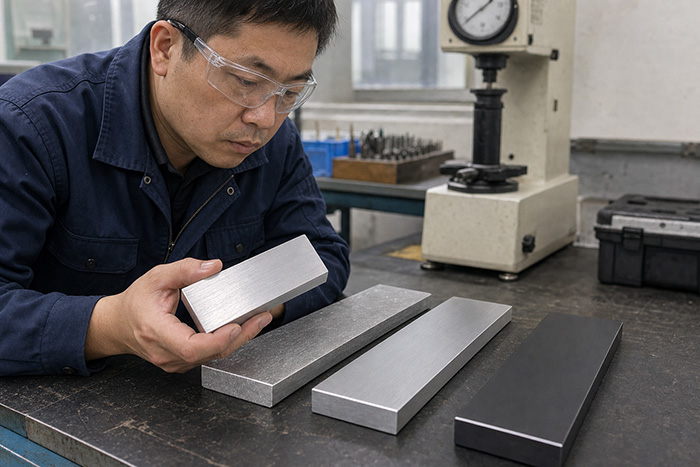
Do not write only “standard tolerance” on a critical order. Identify the standard edition required by the project and call out any tighter controls. Typical items to agree include:
- width and thickness tolerance;
- length tolerance and cut squareness;
- straightness, flatness and twist;
- corner radius and edge finish;
- surface defects, scratches and extrusion lines;
- mill finish, anodising, tin plating or other treatment;
- protective film, paper interleaving and export packing;
- mill test certificate or certificate of conformity;
- conductivity or resistivity test results for busbar material.
Surface finish and fabrication options
Mill finish is suitable for many industrial parts, but appearance-sensitive or corrosive-service components may use anodising or powder coating. Electrical joints require a finish compatible with the connection design. Coatings, oxide control, joint compounds, contact pressure and compatible fasteners must be engineered as a system.
Specialist manufacturers can also provide cutting, punching, drilling, bending, CNC machining, rounded edges, plating and insulation. Ordering a finished or semi-finished component may reduce handling and dimensional variation across multiple subcontractors.
How to Choose the Right Aluminium Flat Bar Size
1. Define the function
First decide whether the bar is a structural member, machined blank, architectural component or electrical conductor. List the governing loads, operating environment, installation space and service life.
2. Select alloy and temper
Prioritise the properties the application actually needs. High-strength 6061-T6 may suit a rigid support or machined assembly, while 1350 or 6101 may be a better starting point for current-carrying service. Consider bending and forming before selecting a hard temper.
3. Determine cross-sectional dimensions
For mechanical applications, check stress, stiffness, buckling, fastener edge distances and corrosion allowance. For electrical applications, determine cross-sectional area from current, allowable temperature rise and installation conditions—not from a generic ampacity table alone.
Busbar performance is influenced by:
- alloy conductivity and operating temperature;
- AC or DC service and frequency;
- enclosure ventilation and ambient temperature;
- bar orientation, spacing and number of parallel bars;
- joint resistance and plated or prepared contact surfaces;
- insulation and permissible temperature rise;
- short-circuit electrodynamic and thermal withstand.
An electrical engineer should validate the final busbar configuration against the applicable equipment standard and project requirements. For application-specific products, review options such as aluminium busbar for switchgear, high-voltage aluminium busbar flat bars and aluminium busbar for new-energy vehicles.
4. Confirm tolerances and downstream processing
A nominal section may not fit after bending, machining or coating. Supply a drawing that identifies finished dimensions, datum points, hole locations, bend radii, deburring and surface treatment. Ask the manufacturer to review manufacturability before production.
5. Validate samples and documentation
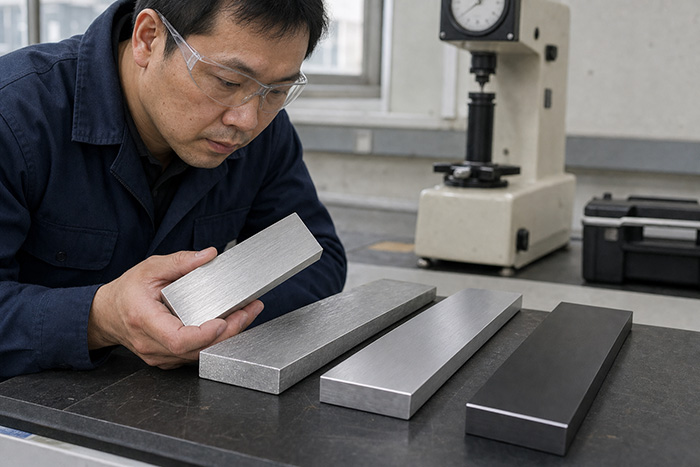
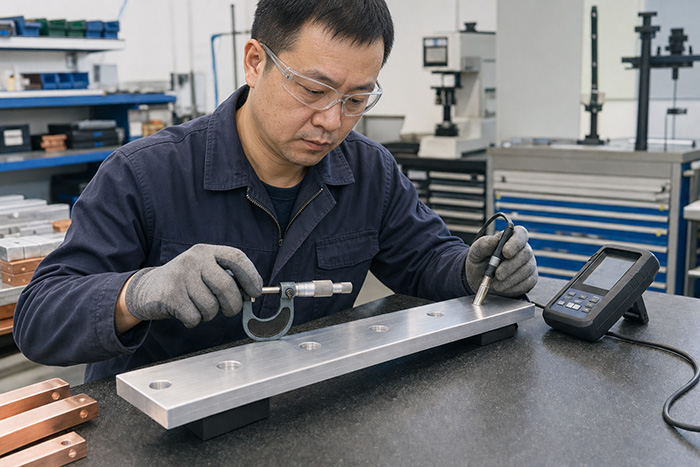
For repeat or safety-critical production, approve a first article or sample. Verify dimensions, alloy/temper certification, surface condition and, where relevant, conductivity and joint performance. Retain agreed inspection criteria with the purchase order.
Aluminium Flat Bar RFQ Checklist
Copy this checklist into your next enquiry:
- Application: structural, machined, architectural or electrical busbar
- Alloy and temper: for example, 6101-T6 or 6061-T6
- Size: width × thickness × length, with units
- Quantity: pieces, total metres or total weight
- Dimensional standard: ASTM, EN, GB/T or project specification
- Tolerances: width, thickness, length, straightness, flatness and twist
- Edge condition: square, rounded, chamfered or deburred
- Fabrication: cut, drilled, punched, bent, machined or welded
- Surface: mill finish, anodised, plated, coated or insulated
- Electrical requirements: minimum conductivity/resistivity and test method
- Inspection documents: certificate of conformity, material test report or third-party inspection
- Packing: protective film, paper interleaving, wooden case and moisture protection
- Delivery: destination, Incoterm and required date
- Drawing: revision-controlled PDF and CAD file where applicable
Providing these details helps the manufacturer quote the correct process, tooling, inspection and lead time. If the exact alloy or tolerance is undecided, state the operating requirements and ask for an engineering review rather than leaving the field blank.
Frequently Asked Questions
What sizes does aluminium flat bar come in?
Common metric aluminium flat bar sizes range from about 10 to 200 mm wide and 3 to 25 mm thick, with stock lengths often between 3 and 6 m. Specialist mills may offer widths up to 600 mm, thicknesses up to 120 mm and custom lengths. Availability varies by alloy and temper.
How is aluminium flat bar measured?
Aluminium flat bar is normally measured as width × thickness × length. A specification of 50 × 6 × 3,000 mm means the bar is 50 mm wide, 6 mm thick and 3,000 mm long. Always include units and any required dimensional tolerances.
How much does aluminium flat bar weigh?
Estimate mass per metre by multiplying width in millimetres by thickness in millimetres by 0.00270. A 50 × 10 mm bar weighs approximately 1.35 kg/m. Actual weight can vary slightly because of alloy density, tolerances and corner radii.
Which aluminium alloy is best for flat bar?
The best alloy depends on the job. 6061 offers a useful strength-machinability balance, 6063 provides good extrudability and finish, 5052 and 5083 suit corrosion-resistant applications, and 1350 or 6101 are common starting points for electrical busbars. Confirm the required temper as well as the alloy.
Can aluminium flat bar be used as a busbar?
Yes, but a suitable busbar alloy, cross-section, joint design and surface preparation must be selected. Current capacity cannot be determined from dimensions alone. Temperature rise, enclosure conditions, AC effects, spacing and short-circuit withstand should be verified by a qualified electrical engineer.
Can aluminium flat bar be supplied to custom sizes?
Yes. Manufacturers can often extrude custom cross-sections or cut standard sections to length, then add holes, bends, rounded edges, plating or insulation. Custom tooling, minimum order quantity and lead time depend on the section, alloy, tolerances and fabrication scope.
Specify the Bar, Not Just the Size
Choosing the correct aluminium flat bar size begins with width, thickness and length, but a reliable specification also defines alloy, temper, tolerances, finish, processing and inspection. Electrical busbars require the added discipline of conductivity, temperature-rise, connection and short-circuit validation.
Henan Meisitu presents itself on this website as a manufacturer of aluminium flat bars and fabricated busbar components for industrial power applications. Buyers should confirm current certifications, manufacturing scope, test capabilities and product availability during supplier qualification. Send your drawing, operating requirements and completed RFQ checklist through the aluminium flat bar enquiry page to discuss standard or custom production.
Sources and Review Basis
The standards descriptions and numerical references in this guide were checked against the following sources on August 1, 2026:
- ASTM B221/B221M: extruded aluminium and aluminium-alloy products, ASTM International.
- ASTM B211/B211M: rolled or cold-finished bar, rod and wire, ASTM International.
- ASTM B236/B236M: Aluminum 1350 bars for electrical purposes, ASTM International.
- IEC 60105: commercial-purity aluminium busbar material, International Electrotechnical Commission.
- Aluminum section-property reference, The Aluminum Association.
- Published aluminium flat-bar size range, Yieh Corp. This is used only as an example of a supplier capability range.
Calculated masses in the size table are editorial calculations based on width × thickness × 0.00270. They are estimates, not measurements or certified product values.