Flat bar purchasing guide
Compare the finished part, not just the starting material.
Choose between extruded and plate-cut aluminium flat bar by comparing the required alloy and temper, finished dimensions, edges, surfaces and total processing cost. Extrusion forms the section through a die; plate cutting produces strips from an existing plate. Either route may need additional work to meet your drawing.
This guide helps buyers compare the two routes on the same basis. A process name alone does not guarantee a tighter tolerance, a cleaner edge or a lower delivered cost.
1. How do the two manufacturing routes differ?
Extruded aluminium flat bar gets its rectangular section from the extrusion process. Plate-cut aluminium flat bar gets its strip width from cutting a parent plate. For this comparison, “plate-cut” means saw-cut strips. Waterjet, laser or other cutting routes should be identified separately in the enquiry.
From starting stock to ordered lengths
Extruded flat bar
- Billet and die
- Extrude the section
- Required treatment
- Cut to ordered length
Plate-cut flat bar
- Parent plate
- Saw into strips
- Cut to ordered length
- Edge finishing if required
The Aluminum Extruders Council's process guide explains how a softened, solid billet passes through a die. For an unmachined rectangular extrusion, the die forms the section's perimeter. With a strip sawn from plate, the broad faces normally remain the plate faces unless further machining is ordered.
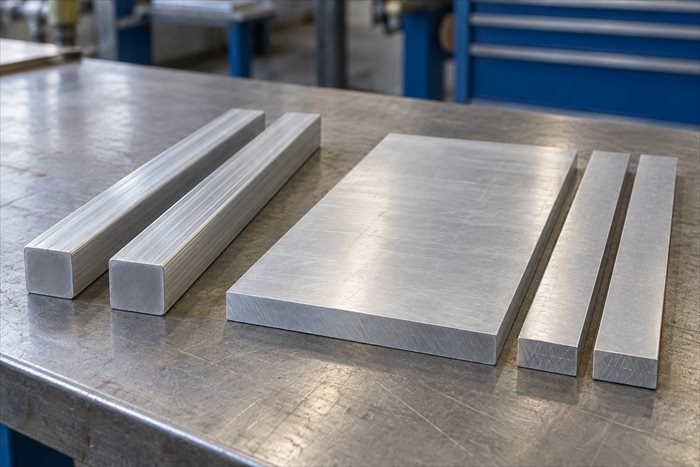
In both cases, the cut ends are a separate feature. A supplied extrusion may still be saw-cut to length; “extruded” does not mean every face on the delivered piece came from the die.
2. Which route gives the dimensions you need?
Ask for confirmed limits for each feature, at the delivery stage you are buying. Separate width, thickness and length from straightness, flatness, twist and cut squareness. These checks describe different aspects of fit.
Clinton Aluminum's cutting-tolerance sheet separates standard and precision services. Hydro's rod-and-bar information likewise distinguishes enhanced-tolerance products from standard requirements. These are supplier-specific examples showing why neither process has one universal tolerance.
Use this table to request comparable quotations. Swipe sideways on mobile.
| Feature | Extruded route | Plate-cut route |
|---|---|---|
| Width and thickness | Confirm section tolerances and any finishing. | Confirm parent-plate thickness and strip-cutting tolerance separately. |
| Length and ends | Agree cut length, squareness and end finishing. | Agree cut length, squareness and end finishing. |
| Flatness and straightness | Request limits for the supplied bar length. | Request limits for the supplied strip, rather than relying only on the parent plate. |
| Corners and surfaces | Confirm corner geometry and acceptable extrusion marks. | Confirm saw-cut edge condition and acceptable plate-face marks. |
3. What should you specify for edges and visible surfaces?
Describe the edge you need after all ordered processing. “Square edge”, “rounded edge”, “deburred” and “machined edge” are different requests. Deburring removes unwanted sharp projections; it does not define a controlled corner radius.
For a face that must fit
Identify the mating face and its required dimensions, flatness and surface condition. If a saw-cut edge must locate against another part, ask whether it can be supplied as cut or needs machining.
For a face that will be seen
Identify visible surfaces and agree acceptable marks, finishing and packaging. Request a representative sample or agreed reference where appearance matters. A mill finish is not a promise of a decorative finish.
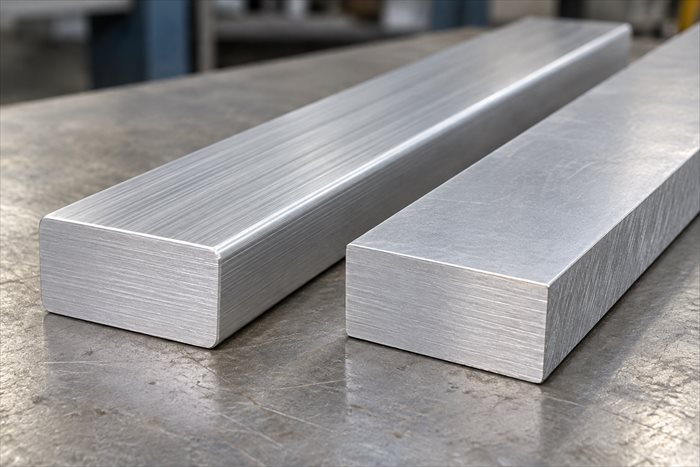
Saw-cut material is not automatically a rough, unusable blank. Clinton Aluminum's equipment information describes precision saw finishes that can reduce later machining for its customers. That capability is specific to its service; ask the proposed supplier to confirm the finish for your order.
Likewise, the Aluminum Extruders Council's fabrication overview lists cutting and machining among operations applied to extrusions. Include any required finishing in the quotation instead of assuming extrusion eliminates it.
4. How do you compare the cost of a usable part?
Compare delivered pieces meeting the same drawing, alloy-temper requirement and inspection scope. A stocked section and a newly tooled extrusion have different starting costs. A plate-cut blank and a fully machined bar include different amounts of work.
Fictional width-check example
A drawing requires 50.0 ± 0.2 mm finished width, so acceptable width is 49.8–50.2 mm. Other dimensions and material requirements are assumed agreed.
Offer A, for an extruded blank, states 50.0 ± 0.2 mm. Offer B, for a plate-cut blank, states 50.0 mm with +1.0/−0 mm tolerance, or 50.0–51.0 mm.
Offer A's stated width range matches the drawing. Offer B's range extends beyond it. Ask for a price and confirmed process to deliver the finished width, including any required allowance and machining, before comparing totals.
All figures are hypothetical quotation inputs, not standard tolerances or confirmed supplier capabilities.
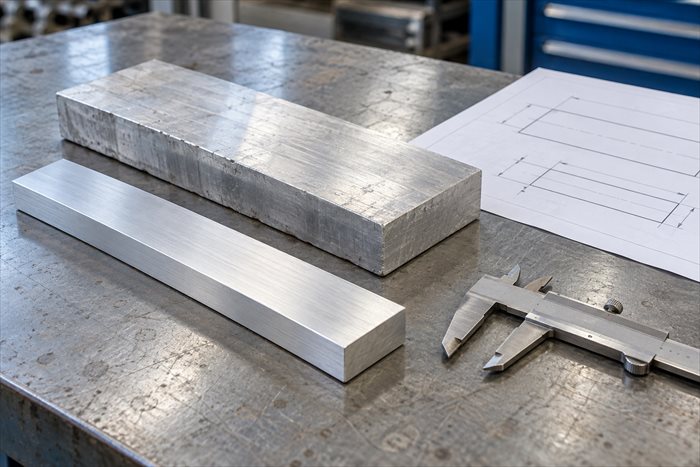
Use the same approach for every critical feature. A dimension matching on paper still needs verification against the supplied product and the remaining drawing requirements.
Build the quotation from these inputs
Material and usable yield + any tooling or setup + cutting + edge or face finishing + inspection + packing and transport.
For extrusion, ask whether a suitable section and die already exist and whether tooling costs are separate. For plate cutting, ask about stock thickness, cutting layout, saw losses and minimum machining allowance. Compare the actual quotes; do not assume one route is always cheaper or faster.
Frequently asked questions
Is “cut to size” the same as plate-cut?
No. Extruded bar can also be cut to size. Ask what the starting stock is and which surfaces are cut or machined. The phrase describes a service without identifying the manufacturing route.
Does the same alloy number make the two routes interchangeable?
No. Check the complete temper, product specification, dimensions and required properties. Any proposed change must satisfy the approved design, including forming or electrical requirements where relevant.
Can one sample approve the whole order?
A sample can help agree appearance or test a fit, but it does not define batch acceptance on its own. Specify which features will be checked, the sampling arrangement and the records required for production deliveries.
Request two routes against one clear specification
Use the sizes and specifications guide to organise the drawing inputs and the aluminium flat bar product range to identify the material family.
Send your alloy, temper, finished dimensions, quantity and drawing revision. Identify critical faces and edges, include your destination, and ask whether extruded or plate-cut supply is proposed, with finishing and exclusions listed separately.