Weight planning for buyers
Start with one bar. Check the whole order. Add packaging separately.
To estimate aluminium flat bar weight, multiply width × thickness × length × density, using consistent units. For a solid rectangular bar and an assumed density of 2.70 g/cm³, weight per metre is width in mm × thickness in mm × 0.00270. Multiply by length in metres and quantity for the order total.
This gives a theoretical metal weight for quotation checks and early planning. It does not include packaging or replace an agreed weighing method.
1. Which formula should you use?
Use the version that matches your length unit. Here, “weight” means mass in kilograms, as commonly used in purchasing. Both shortcuts below assume a full rectangular section with no holes or other material removed.
For weight per metre
kg/m = W × T × 0.00270
W = width in millimetres.
T = thickness in millimetres.
Then multiply by length in metres.
For a cut piece
kg/piece = W × T × L × 0.00000270
W, T and L are all in millimetres.
L = the length of one piece.
Then multiply by the piece count.
The starting point is volume × density. One cubic millimetre is 0.001 cm³, so at 2.70 g/cm³ it represents 0.00000270 kg. That is where the cut-piece multiplier comes from.
Why use 2.70? The thyssenkrupp 6061 material datasheet lists a reference density of 2.70 kg/dm³ at 20°C, equivalent to 2.70 g/cm³. This is a useful estimating assumption, not an exact value for every alloy. Use the density agreed for your specified material when greater accuracy is needed.
2. How does the calculation work in practice?
The following are calculated examples, not measured product weights. All use nominal rectangular dimensions and a density of 2.70 g/cm³.
Example A: find aluminium flat bar weight per metre
For a bar measuring 50 mm wide × 6 mm thick:
50 × 6 × 0.00270 = 0.810 kg/m
A one-metre length is therefore approximately 810 grams. The section size alone tells you kg/m; you still need the length to find the weight of a complete bar.
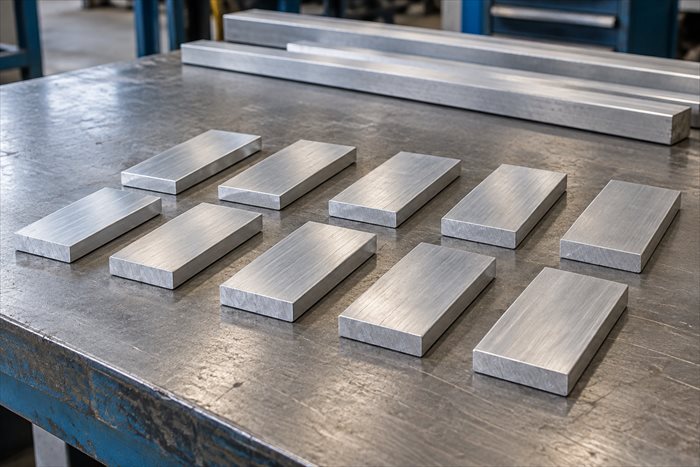
Example B: calculate short cut pieces
For the same section cut to 400 mm, use 0.4 m:
0.810 × 0.4 = 0.324 kg per piece
0.324 × 200 pieces = 64.8 kg
The 64.8 kg is the theoretical net weight of 200 finished rectangular blanks. It does not include saw waste, spare pieces or their packaging.
Example C: calculate full-length bars
For 80 × 10 mm bar supplied in 6,000 mm lengths:
80 × 10 × 0.00270 = 2.160 kg/m
2.160 × 6 = 12.960 kg per bar
12.960 × 40 bars = 518.4 kg
Keep the full calculation value until the final total. Rounding each 12.960 kg bar to 13 kg first would give 520 kg for 40 bars—an avoidable 1.6 kg difference.
| Width × thickness (mm) | Calculated kg/m |
|---|---|
| 30 × 5 | 0.405 |
| 30 × 12 | 0.972 |
| 50 × 6 | 0.810 |
| 50 × 10 | 1.350 |
| 80 × 10 | 2.160 |
| 100 × 10 | 2.700 |
As a separate catalogue check, Alumeco lists its 30 × 12 mm EN AW-6082 flat bar at approximately 0.97 kg/m and explicitly calls the weight theoretical. Our 0.972 kg/m calculation rounds to that value; this does not establish actual weight or availability for another supplier.
3. How do you turn piece weights into a shipment estimate?
Calculate each order line separately, add the metal weights, then add packaging. The worksheet below combines the examples with a third line of 50 × 10 × 500 mm blanks.
Fictional order; all dimensions are width × thickness × length in mm. Swipe the table sideways on mobile.
| Dimensions (mm) | Pieces | kg/piece | Net kg |
|---|---|---|---|
| 50 × 6 × 400 | 200 | 0.324 | 64.8 |
| 80 × 10 × 6,000 | 40 | 12.960 | 518.4 |
| 50 × 10 × 500 | 100 | 0.675 | 67.5 |
| Theoretical net metal weight | 650.7 | ||
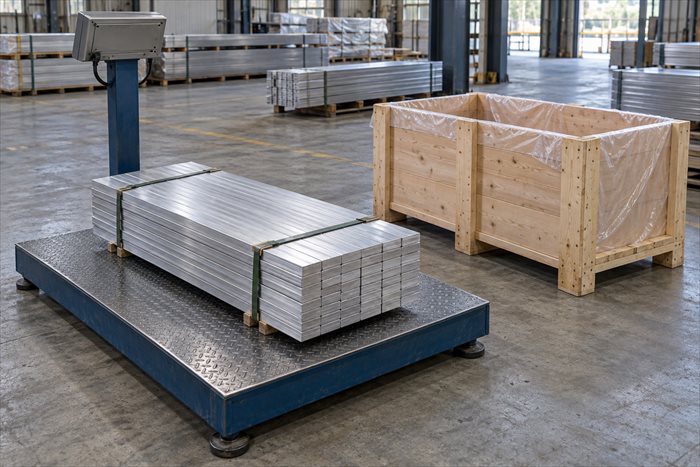
If packaging is provisionally estimated at 38.0 kg:
650.7 + 38.0 = 688.7 kg estimated gross weight.
The 38.0 kg is a hypothetical input, not a standard packing allowance. Confirm the actual crates, supports and wrapping with the supplier, then update the shipment figures.
For your own worksheet, keep separate columns for dimensions, density, piece count, kg/piece and line total. Record whether the result is calculated or weighed. Ask for package dimensions as well as gross weight when requesting freight quotations; this metal calculation alone is not a freight charge calculation.
4. Why might the supplier's weight be different?
First compare the assumptions, not just the final kilograms. Check the alloy density, dimensions, number of pieces and whether the figure includes packaging.
Published alloy-density references show that aluminium alloys do not all have the same density. Dimensional differences also change the result: a hypothetical 50 × 6.1 mm section calculates to 0.8235 kg/m instead of 0.810 kg/m. This illustrates sensitivity to thickness; it is not an allowable tolerance.
Rounded corners, drilled holes and machined recesses remove volume from the full rectangular estimate. Added coatings or attached parts can add weight. For finished components, use the actual geometry and material basis, or an agreed weighing procedure.
Also confirm whether the quotation is based on theoretical weight, weighed material or purchased stock before cutting. Cutting waste may affect material cost, but waste retained at the workshop does not belong in the finished goods' shipment weight.
Frequently asked questions
Can I use a percentage allowance for all orders?
There is no single allowance that reliably covers dimensional variation, cutting loss and packaging. Keep these items separate so you can see which figure affects product weight, purchase cost or shipping weight.
How do I handle dimensions given in inches?
Convert every dimension to millimetres first: 1 inch equals 25.4 mm. Then use the all-millimetre formula. Do not mix an inch width with a millimetre thickness in the same calculation.
Does kg/m tell me the busbar's current capacity?
No. Weight is a quantity-planning result. Electrical suitability also depends on the material and the equipment design; a heavier bar is not automatically suitable for a particular current.
Send a quantity schedule that is easy to check
Use the sizes and specifications guide to organise your dimensions. If your design specifies 6101, the 6101 aluminium flat bar product page is a relevant starting point.
Send your alloy, temper, dimensions, quantity and delivery destination. Include your calculated net weight and ask the supplier to confirm the quotation's weight basis and estimated packing weight.