Material selection · A buyer’s comparison
Start with 6061-T6 for strength-led parts and 6063-T6 for appearance-led parts—then check the finished component.
When comparing 6061 vs 6063 aluminium flat bar, 6061-T6 is generally the stronger starting point for loaded or extensively machined parts. 6063-T6 deserves consideration when the visible surface and decorative anodising matter most. Neither is an automatic winner: the drawing, fabrication steps and acceptance requirements decide the choice. [1] [2]
This guide helps OEM buyers choose what to compare, avoid unsuitable substitutions and request quotations for the same finished result.
1. Which differences matter to your order?
The alloy number identifies the material composition. T6 identifies a heat-treated condition: solution heat treatment followed by artificial ageing. The same T6 suffix does not give two different alloys identical properties. [4]
On a phone, swipe the table sideways to compare both alloys.
| Buying priority | 6061-T6 | 6063-T6 |
|---|---|---|
| Mechanical duty | Start here when higher strength is important. | Consider where the design confirms its strength is sufficient. |
| Machining | A useful candidate for substantial drilling and milling. | Can be machined; assess the actual operations and finished requirements. |
| Visible finish | Do not assume an acceptable decorative result without a sample. | A useful starting point for decorative anodised surfaces. |
| Buying price | Compare the same dimensions, processing, inspection and finish. Alloy alone does not determine the finished-part cost. | |
Selection tendencies are supported by Hydro’s alloy guidance; they are not guarantees for every section or supplier. [1] [2]
2. What happens after the bar is supplied?
Drilling and milling: compare finished parts
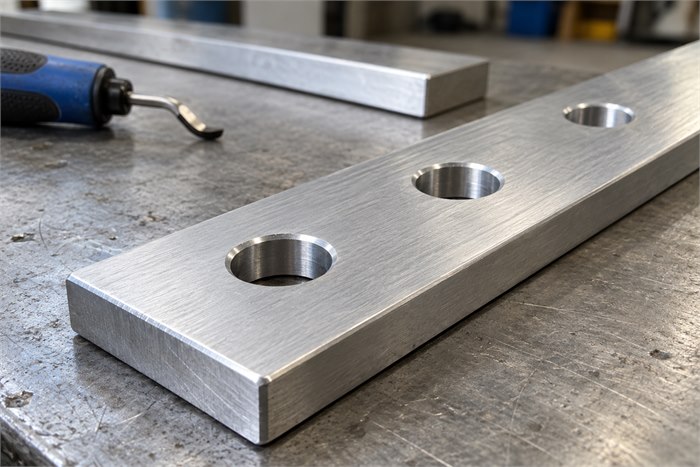
6061-T6 is a sensible candidate for machining, but it does not remove the need to plan the process. Hydro notes that drilling chips can be difficult to break. Ask the fabricator to confirm hole positions, burr removal and the dimensions after machining. [1]
A quotation for a sawn blank is not equivalent to a quotation for a drilled, deburred and inspected component. Send the same drawing revision to each supplier and separate material cost from machining and inspection charges.
Anodising: approve the result you will actually see
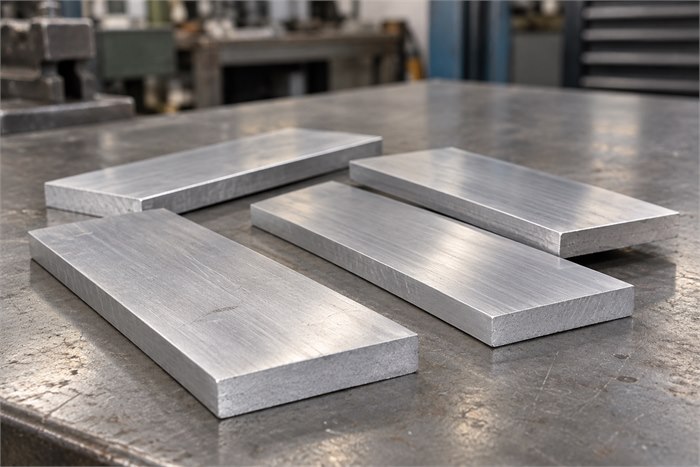
6063 T6 aluminium flat bar is worth evaluating for visible trims and covers. Hydro identifies 6063 with surface quality and anodising, while thyssenkrupp describes it as a commonly anodised extrusion grade. However, anodised shade can vary between batches. [2] [5]
Mark the visible faces on the drawing. Agree surface preparation, colour, acceptable marks and a reference sample made with the intended finishing route. If several bars sit next to one another, ask how their appearance will be matched and protected during packing. “Silver anodised” alone leaves too much room for interpretation.
Bending or welding: agree the sequence first
Do not choose 6063-T6 simply because a general description calls 6063 formable. Bend radius, thickness and temper need a process review. Hydro’s 6061 guidance points to softer conditions for more severe bends and warns that welding can reduce strength around a T6 weld. Specify the required condition and properties after fabrication. [1]
3. Same size, different purchasing decisions
Original teaching example—not a load calculation or a customer case: two buyers need 50 × 5 × 300 mm flat parts, stated as width × thickness × length. Both parts are unwelded, used at room temperature and made from an extruded section. Their requirements differ.
For a preliminary material screen at 5 mm thickness, the cited extrusion tables list minimum 0.2% proof strengths of 240 MPa for 6061-T6 and 170 MPa for 6063-T6. Proof strength is a material-test measure related to permanent deformation; it is not an allowable component stress. The referenced tables use EN 755-2:2016 for extruded profiles. Confirm the applicable product classification, specification and certificate for the order. [3] [4]
Order A · Hidden mounting part
The engineer requires at least 200 MPa proof strength
This is an assumed project requirement, not a recommendation for other designs. The 6061-T6 reference minimum clears this material screen. The 6063-T6 reference minimum does not demonstrate compliance.
Buying action: request 6061-T6 evidence for the supplied section. Do not accept a 6063 substitution based only on matching dimensions or a lower price. Component design still needs approval.
Order B · Visible cover strip
Both alloys have already passed the mechanical review
The remaining priority is a consistent decorative anodised appearance across neighbouring pieces. Additional strength is not the deciding requirement.
Buying action: start the finish evaluation with 6063-T6. Approve a representative finished sample and the appearance criteria before comparing production quotations.
The method is reusable: reject options that do not demonstrate mandatory requirements, then compare processing, appearance and cost among the remaining options. Do not turn an alloy preference into permission to change an approved drawing.
4. What should your enquiry include?
Start with the 6061-T6 flat bar product page or the 6063 flat bar product page, then confirm the exact temper and finished requirements. The second page covers several tempers, so specify T6 explicitly when required.
Copy and adapt this enquiry note
“Please quote to the attached drawing revision. State the alloy, temper and manufacturing route; finished width × thickness × length and tolerances; drilling or milling; edge finish; and inspection documents. For anodised parts, identify the visible faces, surface preparation, colour reference and sample approval requirement. List any proposed material or temper substitution separately for approval.”
Add quantity, destination and required delivery date. For help arranging the dimensional information, use the flat bar sizes and specifications guide.
Frequently asked questions
Can I tell 6061 and 6063 apart by looking?
Appearance is not reliable proof of alloy or temper. Check the material documents and their connection to the delivered batch. A smooth surface does not establish that the bar is 6063-T6.
Is 6063-T6 always cheaper?
No universal price ranking applies. Ask for comparable quotations covering quantity, section, tolerances, machining, finish and packing. A cheaper blank can produce a more expensive finished component if extra processing is required.
Which is better for an electrical busbar?
This mechanical and appearance comparison cannot select a current-carrying design. Specify conductivity or resistivity, dimensions, joint details and operating conditions. Confirm temperature rise and the applicable equipment requirements rather than choosing either alloy from its T6 label alone.
Request a quote around your finished-part requirements
Send your drawing, application and quantity through the aluminium flat bar enquiry page. Identify the strength or appearance requirement that matters most, so the proposed material, processing and inspection scope can be discussed against a clear specification.
Sources and further reading
[1] Hydro: Alloy 6061 data sheet, revision 2019/01. Machining, bending, welding and finishing guidance.
[2] Hydro: 6063 alloy guidance. Application, machining and appearance considerations.
[3] thyssenkrupp Materials Services: EN AW-6061 material data sheet, MX/TIS_06.2018, page 3. Extruded-profile mechanical values and reference elastic modulus.
[4] Hydro: EN AW-6063 extruded-products data sheet, revision 4, March 2023, pages 1–2. T6 mechanical values, temper definitions and reference physical properties.
[5] thyssenkrupp Materials UK: Anodising aluminium. Visible surfaces, packing and possible batch-to-batch shade variation.